





在Instagram上关注我们
不仅仅是一家户外用品公司

@sawyerproducts
Follow us on Instagram


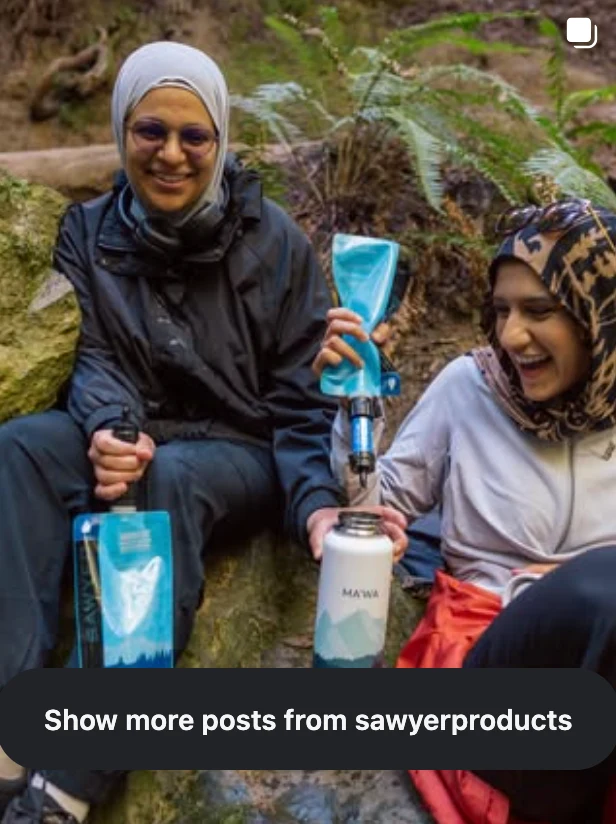
The first of a new series, To Meet a Place, Sydney Williams takes us back to her roots with Sawyer as we follow her footsteps along the Timerline Trail.
Watch videoThere are some moments in nature that are so beautiful they stop you in your tracks.
On the second day of our four-day backpacking trip around Mount Hood, this one started with the light.
Around the next bend, I saw the most spectacular waterfall. Water moved over moss-covered rocks as far as I could see up and down the slope. The light was otherworldly—soft and bright, like fairies, leprechauns, and other mythical forest beings might poke their little heads out from behind the misty rocks at any moment.
“Can you help me?” I asked Barry. “I’d like to camel up on some cold water, and my filter is in my top pocket.”
He handed me my Sawyer filter and the collapsible bladder I use to collect water. I found a place where the waterfall poured over the mossy rocks, filled the bladder, attached the filter, and squeezed the water directly into my mouth.
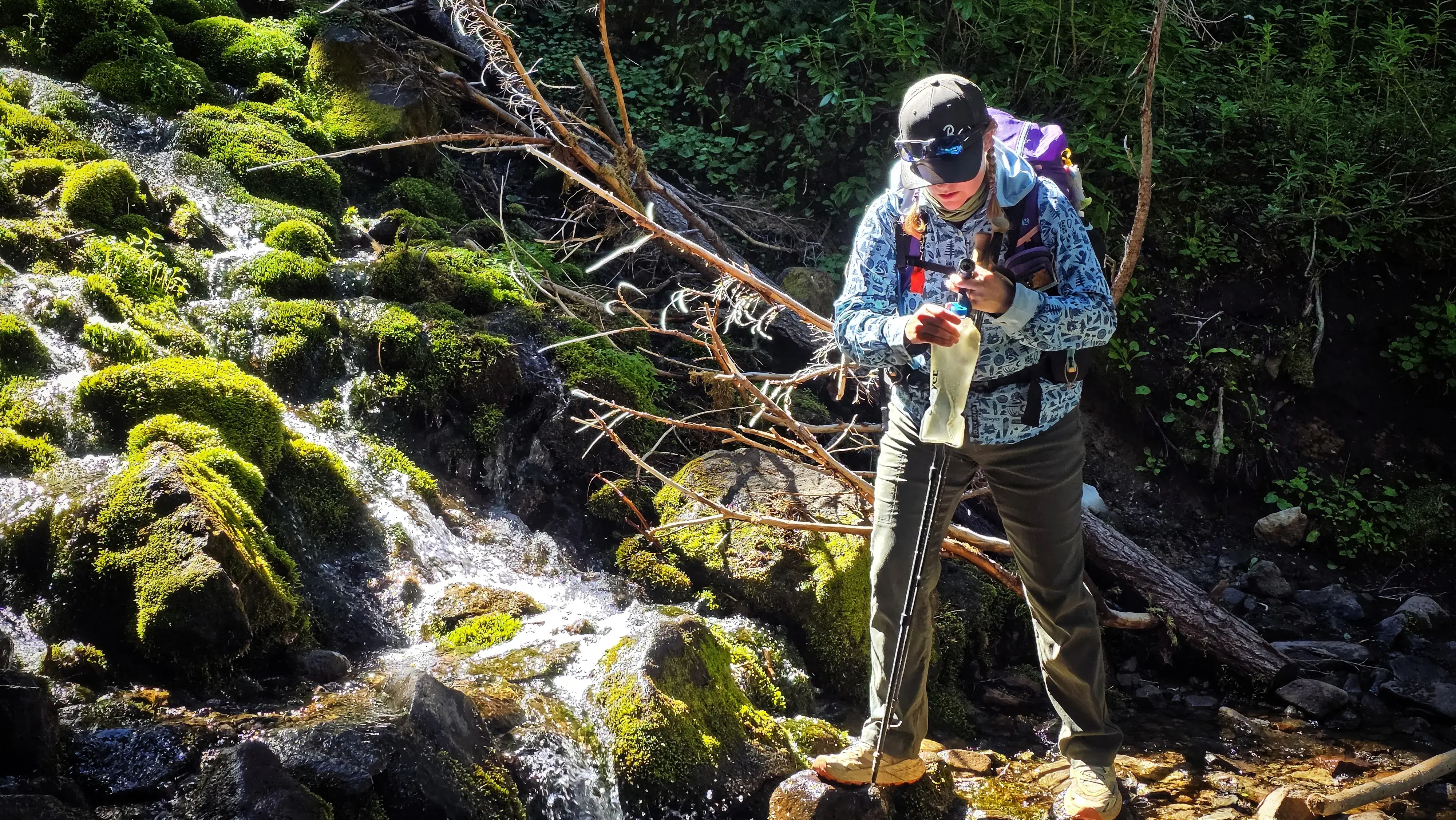
Ice cold.
This water was wet.
This mountain tasted good.
If you have had the privilege of drinking crystal-clear water directly from its source instead of from a faucet connected to a treated water line, you know exactly what I mean.
I drank deeply, refilled the bladder, and carried it across the creek. Once on the other side, I removed my hat, sunglasses, and the phone attached to my shoulder strap. I leaned forward and poured the water over the back of my neck. The cold shocked my system and cooled me instantly.
Then I stood upright, tilted my head back, and poured the rest along my hairline. Melted snow and glacial water ran over my head, carrying away the heat and tension I had generated all morning.
A Timberline trailside baptism.
I felt grateful for Sawyer—for the technology, for a family-run business that had continued showing up for us year after year, enabling us to do our best work and helping our community access clean water wherever their travels took them. For the way they reinvested their profits into clean-water projects around the world.
Water is life, and Sawyer had helped keep our work alive.
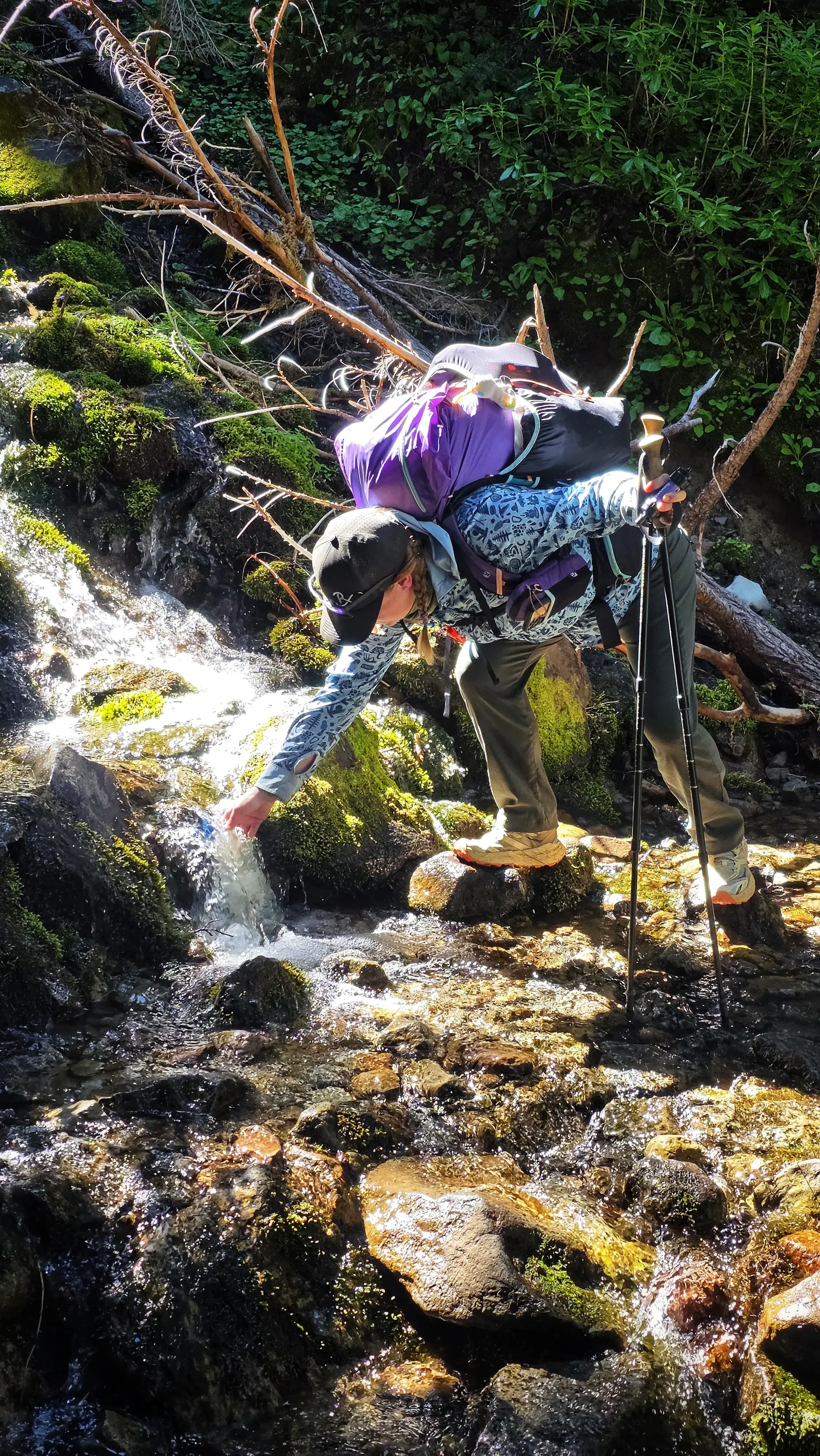
I’ve filtered water hundreds of times.
At this point, it’s one of the most routine parts of backpacking. Find a water source. Fill the bladder. Attach the filter. Drink. Refill whatever bottles need refilling. Keep walking.
If I hadn’t needed water that afternoon, I probably still would have stopped. I would have taken a picture of the sunlight dancing across the water and tried to capture the way it moved over the moss-covered rocks. I would have locked the scene somewhere in my memory, rock-hopped my way across the stream, and continued toward camp.
Instead, the filter gave me a reason to stay.
Maybe that’s part of what our gear does for us.
We carry tents because we want to sleep somewhere without a roof. We carry layers because the weather changes. We carry food because walking around a mountain makes a person very hungry. We carry water filters because the human body has yet to evolve beyond its inconvenient dependence on clean drinking water.
The equipment makes the adventure possible. What we notice along the way determines how much of the experience we carry home.
And standing beside that stream on Mount Hood, the filter in my hand carried memories of its own.
Sawyer first showed up in our work in 2021, when Hiking My Feelings was in the middle of our Take a Hike Diabetes campaign. We were traveling around the country inviting people to spend time outside, explore the connection between nature and their health, and rethink what might be possible in their own lives. Sawyer offered a prize pack for program participants.
It was a relatively small yes.
Then they kept saying yes.
Over the years, Sawyer has provided filters, sunscreen, and insect repellent for our programs in Sequoia, Yosemite, Joshua Tree, Redwood, Glacier, Yellowstone, Grand Staircase Escalante, and the local communities we’ve visited along the way. They sponsored our Wellness in the Wilderness podcast. I had the chance to hike a section of the Pacific Crest Trail with one of their employees and a group of journalists learning about their products and charitable work.
In 2023, they invited me to moderate a panel at Outdoor Retailer called People Over Profit.
Afterward, I sat down for dinner with members of the Sawyer team, ambassadors, charitable partners, and some of the people who had joined me on the panel. My friend and now fellow Sawyer Ambassador Gabaccia and I split a molcajete that was basically a giant stone bowl full of meat. We had spent the day at a trade show, we were starving, and by the time dinner arrived we felt like two little raccoons hunched over the table eating everything we could get our hands on.
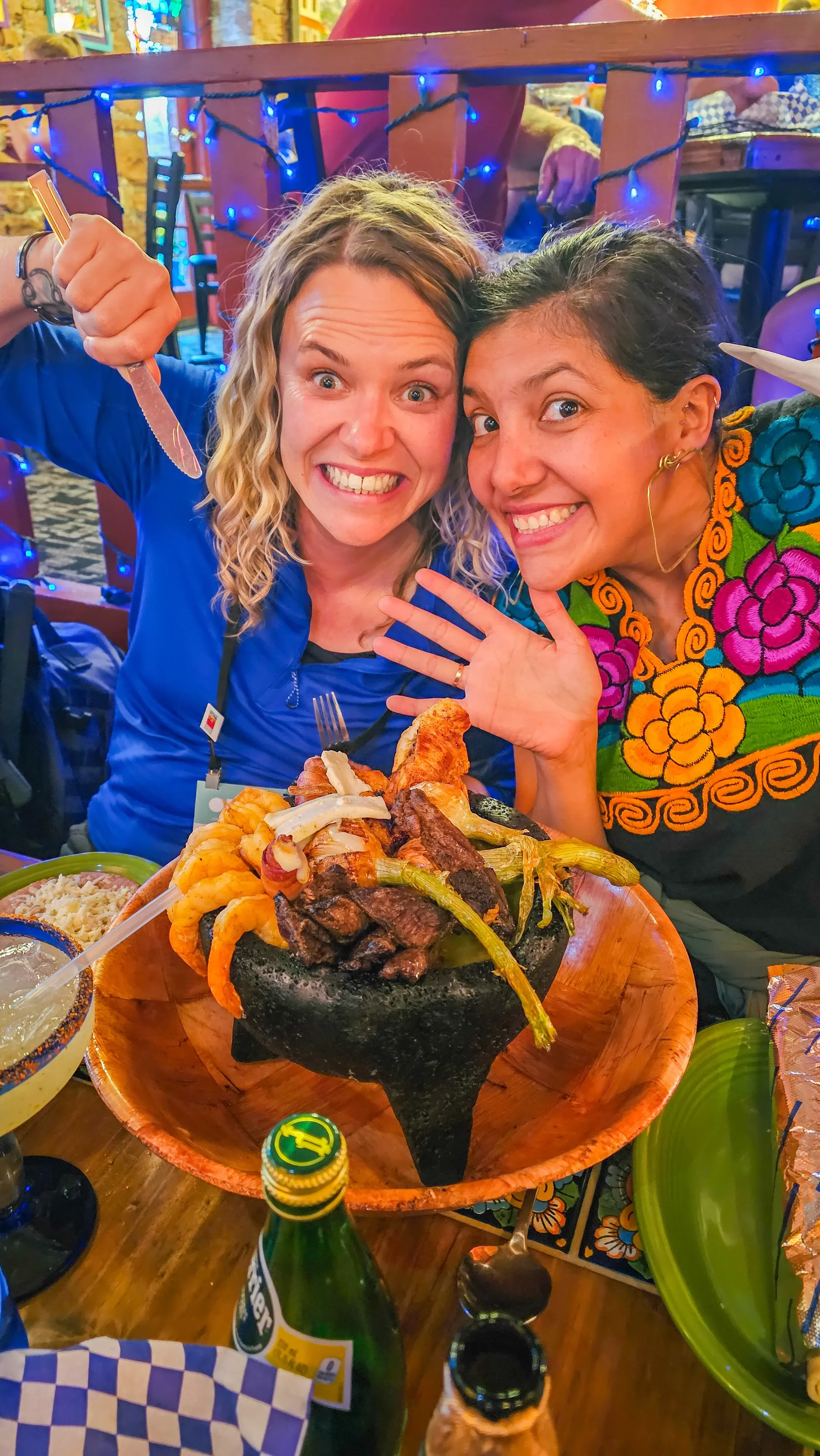
Somewhere in the middle of our raccoon feast, one of the panelists shared a story about a time when their business had gotten thin.
They had put everything on the line. The future of what they were building wasn’t guaranteed, and Sawyer believed in them. They helped them through the gap, and the business kept going.
As I listened, I realized something.
We weren’t the only ones.
By then, Barry and I knew what it felt like to wonder whether belief in the work would be enough to keep the work alive.
There had been times when we genuinely wondered whether we needed to hang it up. We knew where we wanted Hiking My Feelings to go. We could see the impact of the programs and the relationships forming around them. We also knew that believing deeply in something does not magically make the math work.
Sometimes the gift of belief is all we need.
Sometimes that gift comes through conversations between business owners, sponsors, athletes, ambassadors, friends, and people who understand how vulnerable it can feel to build something you care about. Sometimes it sounds like, “Keep going.” And sometimes it comes with financial support that helps bridge the gap between where we are and where we’re trying to go.
Sawyer has given us both.
Their support has mattered because it feels good to be included, thought of, and believed in. I’ve also learned that this way of showing up is deeply connected to how they operate their business. They sell water filters so they can help bring clean water to communities around the world.
I wish more businesses operated this way.
This year, their support helped us host two volunteer reunions in Yosemite and Sequoia National Parks, where our community contributed to restoration work at Ahwahnee Meadow and Round Meadow. These weren’t explicitly clean-water projects, but healthy meadows retain water, support plants and wildlife, and contribute to the larger watersheds they belong to.
I love the circle of that.
A company that makes tools for accessing clean water helps support a community caring for landscapes that hold water, and a few months later, I’m standing beside a stream on Mount Hood with one of their filters in my hand, thinking about all the places we’ve traveled together.
水就是生命。
Relationship is built over time.
Maybe places work that way, too.
________________________________________________________________________________________________________________________
I didn’t go to Mount Hood intending to start a new writing project.
I went because I wanted to hike the Timberline Trail.
Barry and I spent four days walking roughly forty miles around the mountain, carrying everything we needed on our backs and moving through forests, burn scars, wildflower meadows, glacial rivers, blowdowns, exposed ridgelines, and more ecosystems than I fully understood while I was walking through them.
Then I came home and started writing.
In my Notes app.
With my thumbs.
22,713 words.
Twenty-two thousand, seven hundred and thirteen words typed with my thumbs before I finally moved everything into a Google Doc like a person who had access to an actual computer the entire time.
This was a diabolical decision.
Once I moved everything over, the writing kept growing. I tinkered. I researched. I remembered. I went back through photographs and maps.
When I hike, I drop pins and take pictures at major moments. Beautiful views. Difficult sections. Places I cry. Places something happens that I know I’ll want to remember later. At the time, I’m usually trying to document the experience. When I started writing about Mount Hood, those little digital markers became breadcrumbs.
A timestamp on a photograph helped me figure out how long we’d spent navigating a particularly brutal section of blowdown. A waypoint helped me locate where something had happened so I could research the ecosystem we were traveling through at that elevation. Pictures brought back details I’d forgotten by the time we reached camp, let alone by the time I sat down to write.
I had already walked around Mount Hood once.
Writing became another way around.
The longer I followed those breadcrumbs, the more I realized how much of the experience I hadn’t fully understood while I was living it. The hike kept opening. The mountain kept giving me things to research, remember, laugh about, reconsider, and connect.
Somewhere in that process, I realized I had fallen in love with writing again.
And somewhere in the writing, one question stopped me the same way that stream had:
What would it look like to meet a place instead of consuming it?
I got full-body goosies when I wrote it.
There was something in that question that reached beyond these four days on Mount Hood. I have spent years thinking about what becomes possible when our outdoor experiences deepen into relationships, when recreation leads us toward reciprocity, and when enjoying a place also invites us to care about what happens to it after we leave.
Suddenly, I could see what all this writing had been trying to show me:
To Meet a Place: An ongoing collection of essays about the landscapes we move through and the relationships we develop with them.
Because apparently, spending four days walking around a mountain and then writing approximately 24,000 words about it is how I relax now.
And lest “essays about landscape and relationship” make this sound unbearably reverent, I should probably clarify what actually happens when Barry and I are left unsupervised in the wilderness.
At one point, we needed to cross the Muddy Fork.
My options were walking across a humongous fallen tree that had either landed perfectly over the creek or been heroically placed there by the hiking gods and goddesses, or wading into fast water with steep banks that looked deeper than anything we had crossed so far.
Barry started across the tree first. The walkable surface was probably a foot wide, but rounded, polished smooth by seasons of hikers using it to cross, and slippery in spots. It sat somewhere between five and ten feet above the water. Barry took a few steps, backed up, lowered himself onto all fours, and crawled across. The tree was solid, and more points of contact were good.
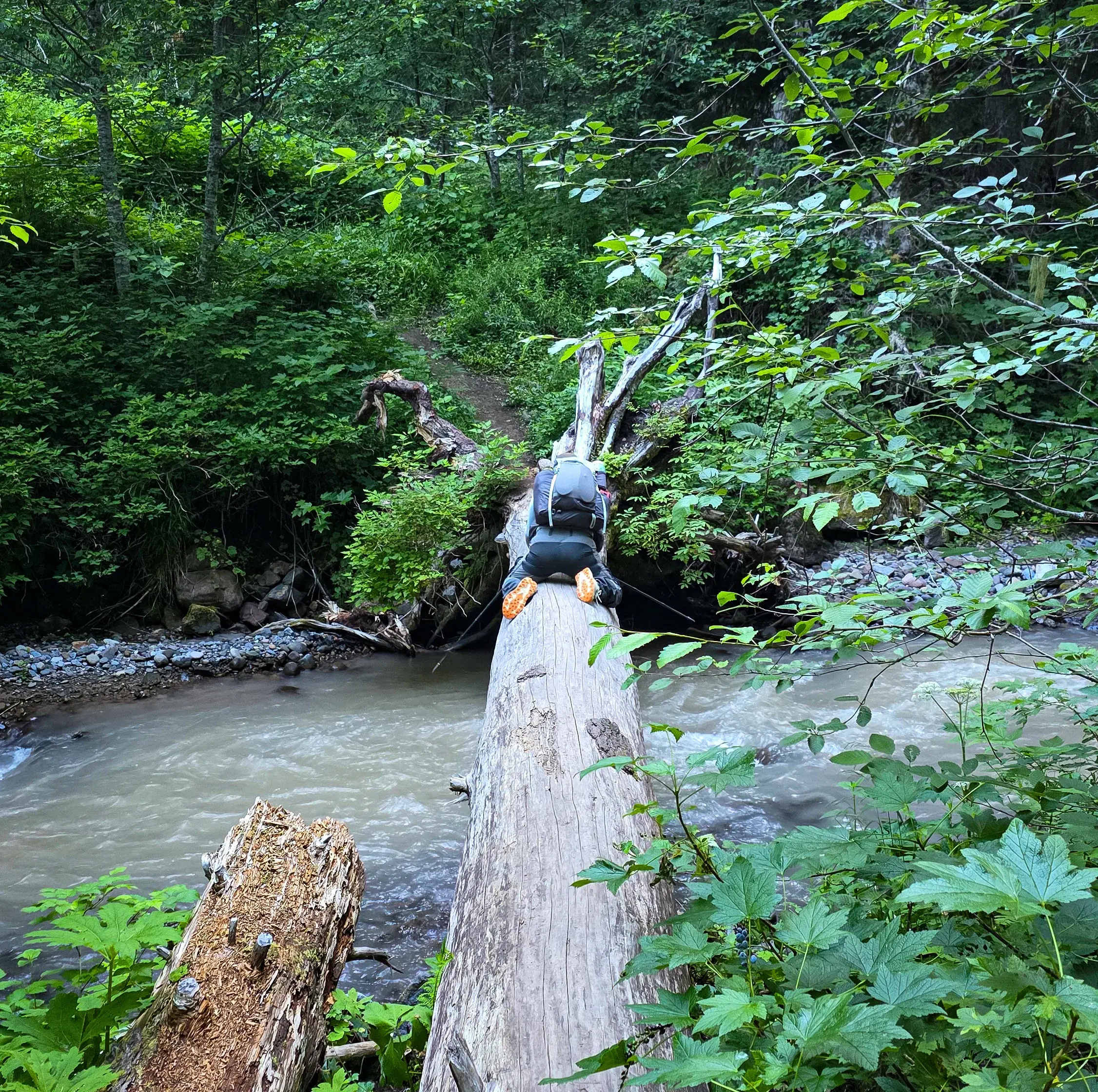
He made it safely to the other side, and I began assessing the most comfortable way for me to follow. Hands and knees weren’t an option. One weird poke to a wrist or kneecap could startle me into overcorrecting and rolling straight off the tree.
So I straddled it.
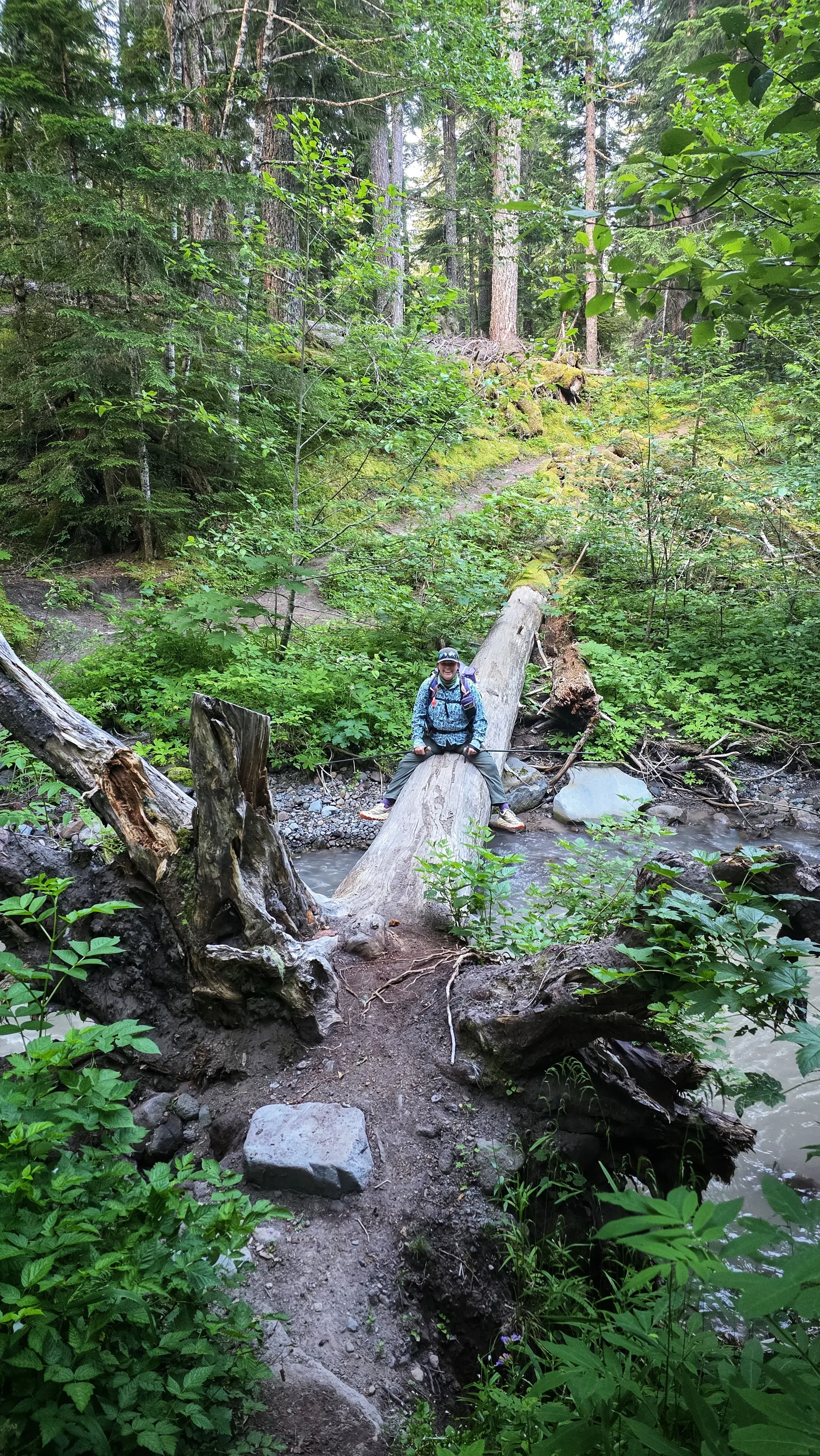
Instead of crawling, I sat, lifted my butt so I wouldn’t drag my ass across the log like a dog in the grass, and performed a weird scoot-shimmy maneuver designed to prevent my pants from splitting at the seams. I felt like an Olympian inventing a routine on a new apparatus that was part balance beam, part pommel horse. Or maybe I was a backpacking AJ McLean, my favorite Backstreet Boy, getting far too intimate with the stage when “Lay Down Beside Me” came up on the set list.
Style points and awkwardness aside, you’ll be delighted to know I made it across safely. My dismount was a 10 out of 10 in that I did not roll off the log, get a splinter in my ass, or rip my pants.
Win, win, win.
There are several ways to develop a relationship with a landscape.
Maintaining the structural integrity of your pants while dry-humping a log over raging water is apparently one of mine.
And then there was our second night on the trail.
We had reached Elk Cove, set up camp beneath Mount Hood, and were preparing to walk back to the creek for water, glacier-fed hummus, and a much-needed soak when I heard Barry behind me.
“F- yeaaaaaah.”
His phone was pointed toward the mountain.
The Milky Way would rise directly over Mount Hood that night. We had a prime spot for astrophotography, star trails, and watching for UFOs.
What do clubbing, concerts, and astrophotography have in common? They all require me to stay up way past my bedtime.
Clubbing was short-lived when I lived in Florida and was strictly reserved for the gay bars in Orlando and a couple of wild nights in South Beach for a bachelorette party. Otherwise, it has never been my scene. Apparently, if I did club drugs, it might have been very much my scene. Instead, I was whistling back vodkasodasplashcrans—it’s one word if you’re white-girl wasted—as if that were my drink of choice. It wasn’t, but it was the most calorically aligned with my early-twenties mission of taking up the least amount of space possible.
Apparently, vodka and deep bass only mix well until a certain point, and then the deep bass turns into a throbbing headache. Dear reader, if you’ve done club drugs and have an accurate recounting of how it works, please feel free to get in touch and tell me all about it.
For accuracy.
Outside of acoustic jams around the campfire or a casual house party, I haven’t been down for a concert since 2022. Turns out I have never really enjoyed crowds, but I’ve been very good at pretending I do. Apparently, when society stopped masking for the sake of our health and that of those around us, I stopped masking in a bazillion other ways as well. Being in crowds was collateral damage, so I don’t stay up or out late for music anymore.
Which leaves astrophotography.
On days when I haven’t been hiking all day, climbing thousands of feet, exhausting my executive function, and draining my proverbial batteries on the trail, I am ALL IN. Some of my favorite photos and moments shared with Barry, friends, and our program participants have happened under starry skies or while trying to find the perfect shot. I love the wonder of the night sky, and I am a huge fan of winter skies in particular because I don’t have to stay up as late to witness them.
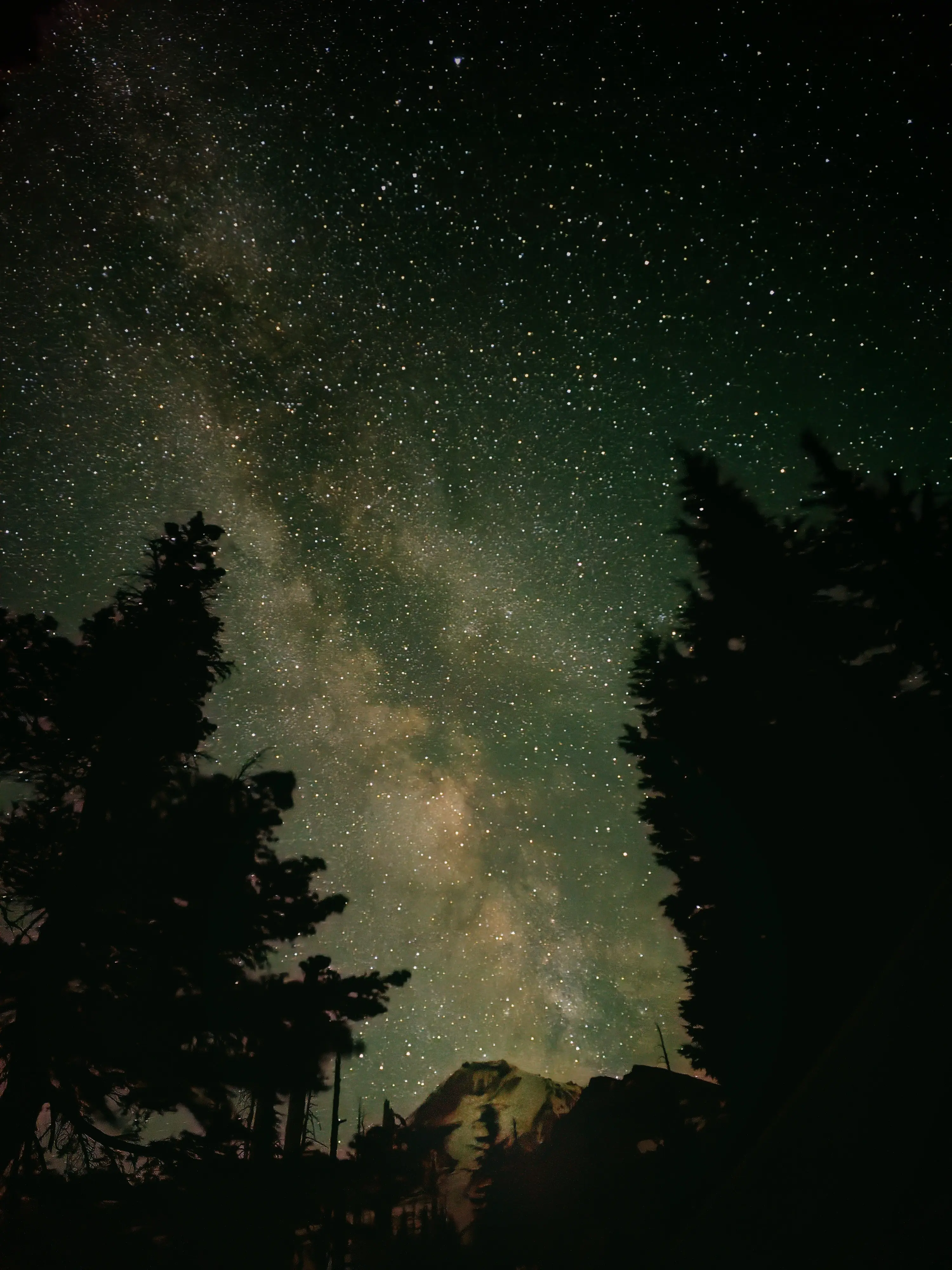
All of which is to say, I was lights out before sunset, slightly sawing logs in the cutest way possible—apparently—and every time I rolled onto another side, my eyes would float open just enough to catch a glimpse of the Milky Way and coo about it before drifting back to sleep.
These were the moments I found when I followed myself back around the mountain.
There were plenty of big ones. River crossings I had worried about before we ever arrived. Miles of downed trees. Physical pain. Fear. Tears. Views that stopped me in my tracks.
But there were also filters and Crocs and hummus and butterflies and jokes and songs. I didn’t sit down with an objective for what Mount Hood was supposed to teach me. I went for a hike, paid attention while I was there, and gave myself enough time afterward to keep paying attention.
Learning can sometimes feel like consumption. Reflection is digestion.
The writing gave me time to digest four days of experience and discover relationships between moments that had felt completely separate while I was living them. Memories from other adventures surfaced. Old fears came along for the hike. Sixteen years of loving and adventuring with Barry were woven through it. The work we’ve spent years building appeared in places I didn’t expect it.
So did versions of myself I hadn’t heard from in a while.
I’m going to leave that part there. There are some things I’d rather let you discover on the trail.
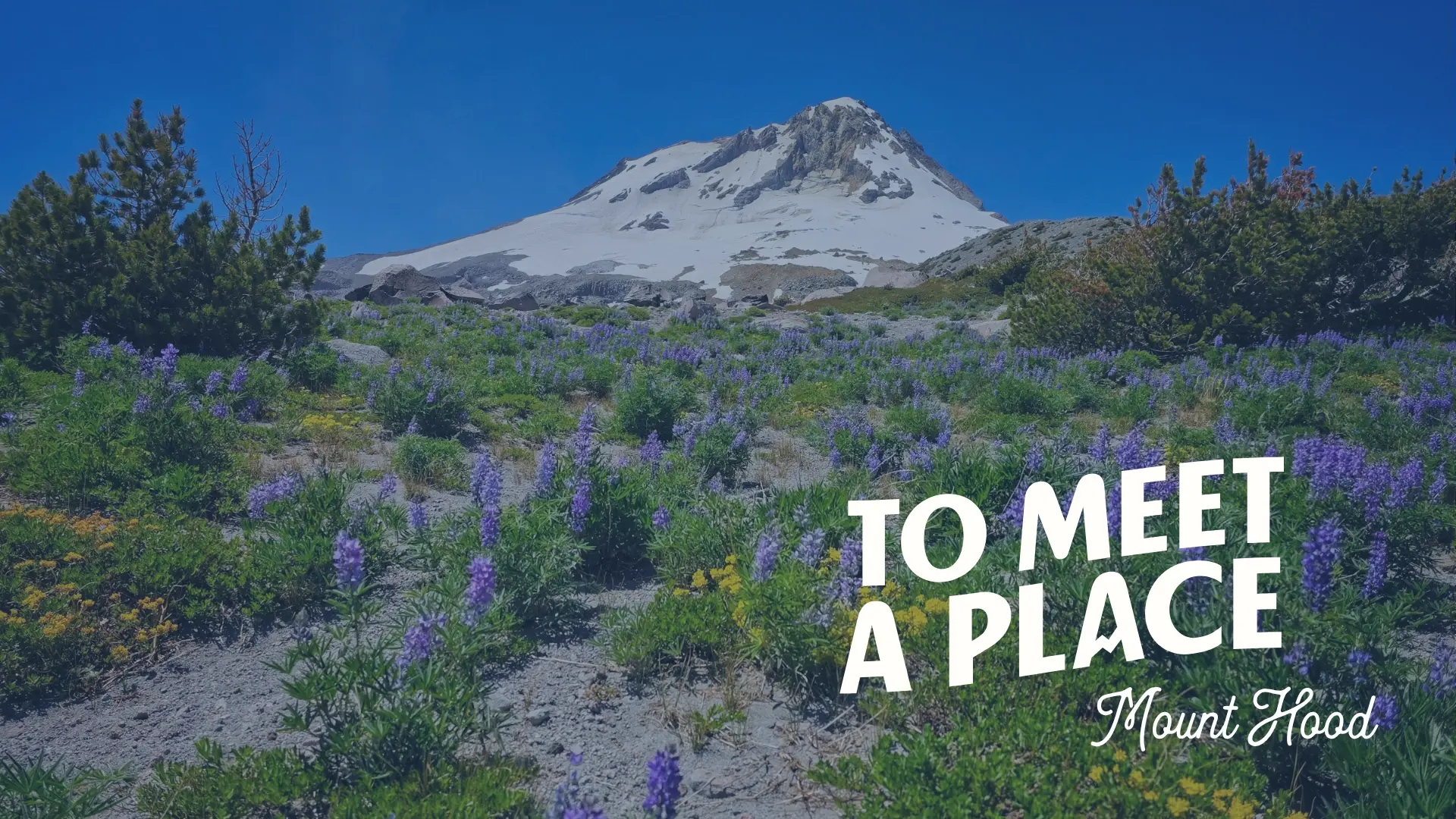
The Mount Hood collection of To Meet a Place begins before our first step and follows us all the way around the mountain, with an introduction and one essay for each day on the trail:
Introduction: How Did We Get Here?
Day 1: Around the Block to Get Next Door
Day 2: Six More Switchbacks
Day 3: We Always Do
Day 4: All of Them Did
Together, they’re somewhere around 24,000 words.
I know.
That is a lot of words about a four-day walk.
But they’re real words. I wrote 22,713 of them with my thumbs, because apparently I enjoy creating completely unnecessary hardships for myself, and then moved them into a Google Doc where I researched, refined, remembered, tinkered, and followed myself all the way back around Mount Hood.
What emerged feels like a love letter to the ways time in nature can change our relationships with ourselves, our communities, and the land itself.
It’s also an invitation.
To slow down. To stay curious. To notice the places we’re moving through and the relationships we’re developing with them. To wonder what we might discover if we gave ourselves enough time to meet a place.
I hope you’ll come walk around this one with me.
Keep walking with me → Read To Meet a Place: Mount Hood on Substack.
There are some moments in nature that are so beautiful they stop you in your tracks.
On the second day of our four-day backpacking trip around Mount Hood, this one started with the light.
Around the next bend, I saw the most spectacular waterfall. Water moved over moss-covered rocks as far as I could see up and down the slope. The light was otherworldly—soft and bright, like fairies, leprechauns, and other mythical forest beings might poke their little heads out from behind the misty rocks at any moment.
“Can you help me?” I asked Barry. “I’d like to camel up on some cold water, and my filter is in my top pocket.”
He handed me my Sawyer filter and the collapsible bladder I use to collect water. I found a place where the waterfall poured over the mossy rocks, filled the bladder, attached the filter, and squeezed the water directly into my mouth.
Ice cold.
This water was wet.
This mountain tasted good.
If you have had the privilege of drinking crystal-clear water directly from its source instead of from a faucet connected to a treated water line, you know exactly what I mean.
I drank deeply, refilled the bladder, and carried it across the creek. Once on the other side, I removed my hat, sunglasses, and the phone attached to my shoulder strap. I leaned forward and poured the water over the back of my neck. The cold shocked my system and cooled me instantly.
Then I stood upright, tilted my head back, and poured the rest along my hairline. Melted snow and glacial water ran over my head, carrying away the heat and tension I had generated all morning.
A Timberline trailside baptism.
I felt grateful for Sawyer—for the technology, for a family-run business that had continued showing up for us year after year, enabling us to do our best work and helping our community access clean water wherever their travels took them. For the way they reinvested their profits into clean-water projects around the world.
Water is life, and Sawyer had helped keep our work alive.
I’ve filtered water hundreds of times.
At this point, it’s one of the most routine parts of backpacking. Find a water source. Fill the bladder. Attach the filter. Drink. Refill whatever bottles need refilling. Keep walking.
If I hadn’t needed water that afternoon, I probably still would have stopped. I would have taken a picture of the sunlight dancing across the water and tried to capture the way it moved over the moss-covered rocks. I would have locked the scene somewhere in my memory, rock-hopped my way across the stream, and continued toward camp.
Instead, the filter gave me a reason to stay.
Maybe that’s part of what our gear does for us.
We carry tents because we want to sleep somewhere without a roof. We carry layers because the weather changes. We carry food because walking around a mountain makes a person very hungry. We carry water filters because the human body has yet to evolve beyond its inconvenient dependence on clean drinking water.
The equipment makes the adventure possible. What we notice along the way determines how much of the experience we carry home.
And standing beside that stream on Mount Hood, the filter in my hand carried memories of its own.
Sawyer first showed up in our work in 2021, when Hiking My Feelings was in the middle of our Take a Hike Diabetes campaign. We were traveling around the country inviting people to spend time outside, explore the connection between nature and their health, and rethink what might be possible in their own lives. Sawyer offered a prize pack for program participants.
It was a relatively small yes.
Then they kept saying yes.
Over the years, Sawyer has provided filters, sunscreen, and insect repellent for our programs in Sequoia, Yosemite, Joshua Tree, Redwood, Glacier, Yellowstone, Grand Staircase Escalante, and the local communities we’ve visited along the way. They sponsored our Wellness in the Wilderness podcast. I had the chance to hike a section of the Pacific Crest Trail with one of their employees and a group of journalists learning about their products and charitable work.
In 2023, they invited me to moderate a panel at Outdoor Retailer called People Over Profit.
Afterward, I sat down for dinner with members of the Sawyer team, ambassadors, charitable partners, and some of the people who had joined me on the panel. My friend and now fellow Sawyer Ambassador Gabaccia and I split a molcajete that was basically a giant stone bowl full of meat. We had spent the day at a trade show, we were starving, and by the time dinner arrived we felt like two little raccoons hunched over the table eating everything we could get our hands on.
Somewhere in the middle of our raccoon feast, one of the panelists shared a story about a time when their business had gotten thin.
They had put everything on the line. The future of what they were building wasn’t guaranteed, and Sawyer believed in them. They helped them through the gap, and the business kept going.
As I listened, I realized something.
We weren’t the only ones.
By then, Barry and I knew what it felt like to wonder whether belief in the work would be enough to keep the work alive.
There had been times when we genuinely wondered whether we needed to hang it up. We knew where we wanted Hiking My Feelings to go. We could see the impact of the programs and the relationships forming around them. We also knew that believing deeply in something does not magically make the math work.
Sometimes the gift of belief is all we need.
Sometimes that gift comes through conversations between business owners, sponsors, athletes, ambassadors, friends, and people who understand how vulnerable it can feel to build something you care about. Sometimes it sounds like, “Keep going.” And sometimes it comes with financial support that helps bridge the gap between where we are and where we’re trying to go.
Sawyer has given us both.
Their support has mattered because it feels good to be included, thought of, and believed in. I’ve also learned that this way of showing up is deeply connected to how they operate their business. They sell water filters so they can help bring clean water to communities around the world.
I wish more businesses operated this way.
This year, their support helped us host two volunteer reunions in Yosemite and Sequoia National Parks, where our community contributed to restoration work at Ahwahnee Meadow and Round Meadow. These weren’t explicitly clean-water projects, but healthy meadows retain water, support plants and wildlife, and contribute to the larger watersheds they belong to.
I love the circle of that.
A company that makes tools for accessing clean water helps support a community caring for landscapes that hold water, and a few months later, I’m standing beside a stream on Mount Hood with one of their filters in my hand, thinking about all the places we’ve traveled together.
水就是生命。
Relationship is built over time.
Maybe places work that way, too.
________________________________________________________________________________________________________________________
I didn’t go to Mount Hood intending to start a new writing project.
I went because I wanted to hike the Timberline Trail.
Barry and I spent four days walking roughly forty miles around the mountain, carrying everything we needed on our backs and moving through forests, burn scars, wildflower meadows, glacial rivers, blowdowns, exposed ridgelines, and more ecosystems than I fully understood while I was walking through them.
Then I came home and started writing.
In my Notes app.
With my thumbs.
22,713 words.
Twenty-two thousand, seven hundred and thirteen words typed with my thumbs before I finally moved everything into a Google Doc like a person who had access to an actual computer the entire time.
This was a diabolical decision.
Once I moved everything over, the writing kept growing. I tinkered. I researched. I remembered. I went back through photographs and maps.
When I hike, I drop pins and take pictures at major moments. Beautiful views. Difficult sections. Places I cry. Places something happens that I know I’ll want to remember later. At the time, I’m usually trying to document the experience. When I started writing about Mount Hood, those little digital markers became breadcrumbs.
A timestamp on a photograph helped me figure out how long we’d spent navigating a particularly brutal section of blowdown. A waypoint helped me locate where something had happened so I could research the ecosystem we were traveling through at that elevation. Pictures brought back details I’d forgotten by the time we reached camp, let alone by the time I sat down to write.
I had already walked around Mount Hood once.
Writing became another way around.
The longer I followed those breadcrumbs, the more I realized how much of the experience I hadn’t fully understood while I was living it. The hike kept opening. The mountain kept giving me things to research, remember, laugh about, reconsider, and connect.
Somewhere in that process, I realized I had fallen in love with writing again.
And somewhere in the writing, one question stopped me the same way that stream had:
What would it look like to meet a place instead of consuming it?
I got full-body goosies when I wrote it.
There was something in that question that reached beyond these four days on Mount Hood. I have spent years thinking about what becomes possible when our outdoor experiences deepen into relationships, when recreation leads us toward reciprocity, and when enjoying a place also invites us to care about what happens to it after we leave.
Suddenly, I could see what all this writing had been trying to show me:
To Meet a Place: An ongoing collection of essays about the landscapes we move through and the relationships we develop with them.
Because apparently, spending four days walking around a mountain and then writing approximately 24,000 words about it is how I relax now.
And lest “essays about landscape and relationship” make this sound unbearably reverent, I should probably clarify what actually happens when Barry and I are left unsupervised in the wilderness.
At one point, we needed to cross the Muddy Fork.
My options were walking across a humongous fallen tree that had either landed perfectly over the creek or been heroically placed there by the hiking gods and goddesses, or wading into fast water with steep banks that looked deeper than anything we had crossed so far.
Barry started across the tree first. The walkable surface was probably a foot wide, but rounded, polished smooth by seasons of hikers using it to cross, and slippery in spots. It sat somewhere between five and ten feet above the water. Barry took a few steps, backed up, lowered himself onto all fours, and crawled across. The tree was solid, and more points of contact were good.
He made it safely to the other side, and I began assessing the most comfortable way for me to follow. Hands and knees weren’t an option. One weird poke to a wrist or kneecap could startle me into overcorrecting and rolling straight off the tree.
So I straddled it.
Instead of crawling, I sat, lifted my butt so I wouldn’t drag my ass across the log like a dog in the grass, and performed a weird scoot-shimmy maneuver designed to prevent my pants from splitting at the seams. I felt like an Olympian inventing a routine on a new apparatus that was part balance beam, part pommel horse. Or maybe I was a backpacking AJ McLean, my favorite Backstreet Boy, getting far too intimate with the stage when “Lay Down Beside Me” came up on the set list.
Style points and awkwardness aside, you’ll be delighted to know I made it across safely. My dismount was a 10 out of 10 in that I did not roll off the log, get a splinter in my ass, or rip my pants.
Win, win, win.
There are several ways to develop a relationship with a landscape.
Maintaining the structural integrity of your pants while dry-humping a log over raging water is apparently one of mine.
And then there was our second night on the trail.
We had reached Elk Cove, set up camp beneath Mount Hood, and were preparing to walk back to the creek for water, glacier-fed hummus, and a much-needed soak when I heard Barry behind me.
“F- yeaaaaaah.”
His phone was pointed toward the mountain.
The Milky Way would rise directly over Mount Hood that night. We had a prime spot for astrophotography, star trails, and watching for UFOs.
What do clubbing, concerts, and astrophotography have in common? They all require me to stay up way past my bedtime.
Clubbing was short-lived when I lived in Florida and was strictly reserved for the gay bars in Orlando and a couple of wild nights in South Beach for a bachelorette party. Otherwise, it has never been my scene. Apparently, if I did club drugs, it might have been very much my scene. Instead, I was whistling back vodkasodasplashcrans—it’s one word if you’re white-girl wasted—as if that were my drink of choice. It wasn’t, but it was the most calorically aligned with my early-twenties mission of taking up the least amount of space possible.
Apparently, vodka and deep bass only mix well until a certain point, and then the deep bass turns into a throbbing headache. Dear reader, if you’ve done club drugs and have an accurate recounting of how it works, please feel free to get in touch and tell me all about it.
For accuracy.
Outside of acoustic jams around the campfire or a casual house party, I haven’t been down for a concert since 2022. Turns out I have never really enjoyed crowds, but I’ve been very good at pretending I do. Apparently, when society stopped masking for the sake of our health and that of those around us, I stopped masking in a bazillion other ways as well. Being in crowds was collateral damage, so I don’t stay up or out late for music anymore.
Which leaves astrophotography.
On days when I haven’t been hiking all day, climbing thousands of feet, exhausting my executive function, and draining my proverbial batteries on the trail, I am ALL IN. Some of my favorite photos and moments shared with Barry, friends, and our program participants have happened under starry skies or while trying to find the perfect shot. I love the wonder of the night sky, and I am a huge fan of winter skies in particular because I don’t have to stay up as late to witness them.
All of which is to say, I was lights out before sunset, slightly sawing logs in the cutest way possible—apparently—and every time I rolled onto another side, my eyes would float open just enough to catch a glimpse of the Milky Way and coo about it before drifting back to sleep.
These were the moments I found when I followed myself back around the mountain.
There were plenty of big ones. River crossings I had worried about before we ever arrived. Miles of downed trees. Physical pain. Fear. Tears. Views that stopped me in my tracks.
But there were also filters and Crocs and hummus and butterflies and jokes and songs. I didn’t sit down with an objective for what Mount Hood was supposed to teach me. I went for a hike, paid attention while I was there, and gave myself enough time afterward to keep paying attention.
Learning can sometimes feel like consumption. Reflection is digestion.
The writing gave me time to digest four days of experience and discover relationships between moments that had felt completely separate while I was living them. Memories from other adventures surfaced. Old fears came along for the hike. Sixteen years of loving and adventuring with Barry were woven through it. The work we’ve spent years building appeared in places I didn’t expect it.
So did versions of myself I hadn’t heard from in a while.
I’m going to leave that part there. There are some things I’d rather let you discover on the trail.
The Mount Hood collection of To Meet a Place begins before our first step and follows us all the way around the mountain, with an introduction and one essay for each day on the trail:
Introduction: How Did We Get Here?
Day 1: Around the Block to Get Next Door
Day 2: Six More Switchbacks
Day 3: We Always Do
Day 4: All of Them Did
Together, they’re somewhere around 24,000 words.
I know.
That is a lot of words about a four-day walk.
But they’re real words. I wrote 22,713 of them with my thumbs, because apparently I enjoy creating completely unnecessary hardships for myself, and then moved them into a Google Doc where I researched, refined, remembered, tinkered, and followed myself all the way back around Mount Hood.
What emerged feels like a love letter to the ways time in nature can change our relationships with ourselves, our communities, and the land itself.
It’s also an invitation.
To slow down. To stay curious. To notice the places we’re moving through and the relationships we’re developing with them. To wonder what we might discover if we gave ourselves enough time to meet a place.
I hope you’ll come walk around this one with me.
Keep walking with me → Read To Meet a Place: Mount Hood on Substack.
不仅仅是一家户外用品公司

